
Philips Enterprise AI Chatbot
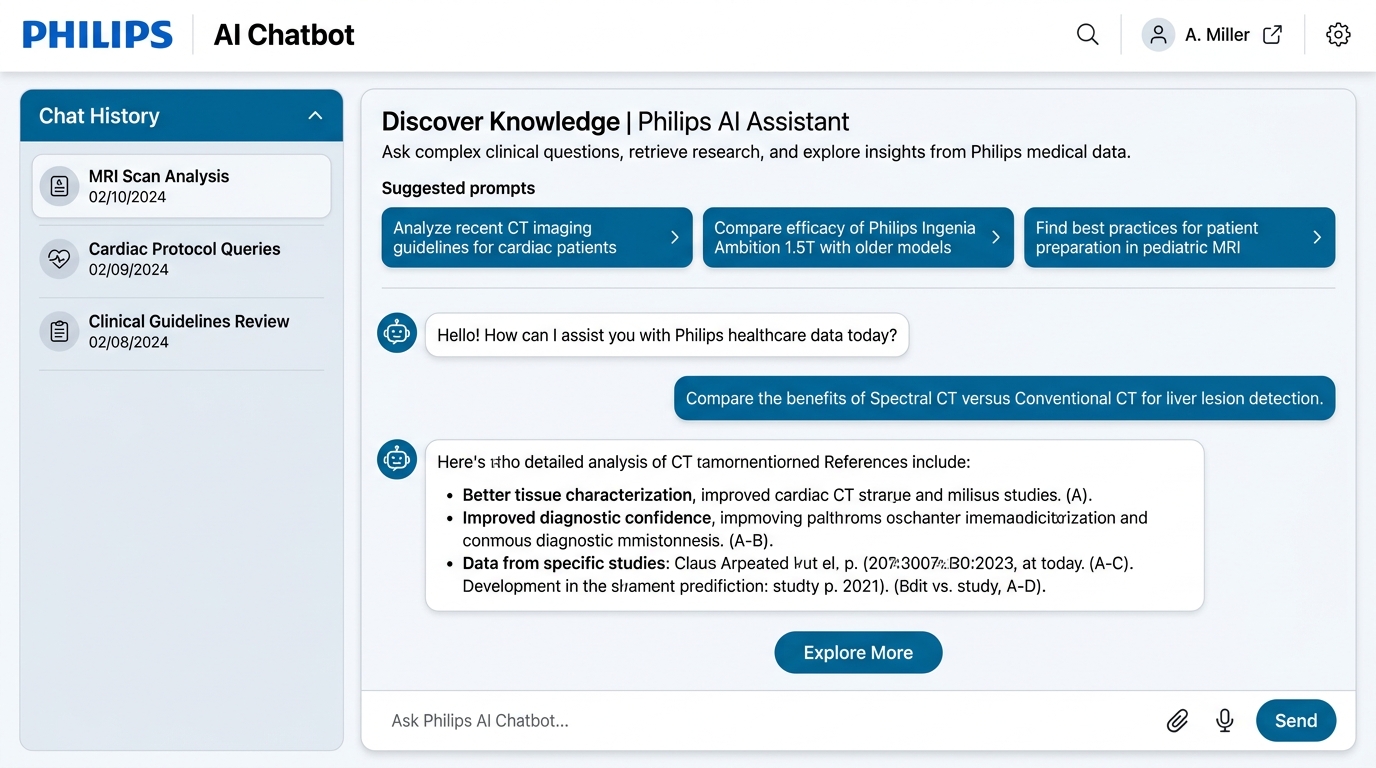
Simplifying enterprise knowledge discovery across patient care, diagnostics, and clinical documentation using structured RAG answers and transparent source citations.
Overview & Context
Philips is a global leader in healthcare technology, delivering innovative solutions across patient care, diagnostics, connected health, and clinical decision support.
As organizations increasingly adopt AI-powered digital assistants to improve employee productivity and customer support, Philips initiated the development of an enterprise AI chatbot capable of providing contextual assistance across internal knowledge bases, product documentation, and operational workflows.
"The objective was to create an intuitive conversational interface that enabled users to quickly retrieve information, interact with AI naturally, and reduce the time spent searching through extensive documentation."
The chatbot needed to seamlessly integrate with existing enterprise systems while maintaining a clean, trustworthy, and accessible user experience suitable for healthcare professionals. As part of the design team, I collaborated closely with a fellow Product Designer to refine the user interface, improve interaction patterns, iterate on key conversational screens, and build interactive prototypes that aligned with Philips' enterprise design standards.
Problem Statement
Healthcare organizations maintain vast repositories of technical documentation, product manuals, clinical protocols, and operational guidelines. Accessing the right information often requires navigating multiple systems, resulting in slower decision-making and increased dependency on support teams. The existing workflow presented several challenges:
Scattered Platforms
Users spent considerable time searching across multiple documentation platforms.
Context Deficiencies
Information retrieval lacked contextual relevance to active clinical workflows.
Search Limits
Traditional search interfaces struggled to interpret complex natural language queries.
Trust Concerns
The chatbot experience needed to inspire trust while handling critical medical information.
The core challenge was to design a conversational experience that simplified enterprise knowledge discovery while maintaining clarity, usability, and confidence in AI-generated responses for both novice and experienced users.
Goals & Success Criteria
The project aimed to achieve the following objectives:
Conversational Interface
Design an intuitive conversational interface for enterprise users supporting natural language dialogue.
Reduced Search Time
Reduce the time required to locate relevant manuals and clinical protocols.
Source Transparency
Increase user confidence through transparent and explainable AI interaction source links.
Scalable Design
Deliver a scalable design system capable of supporting future AI-assisted features.
"Success would be measured through improved task completion efficiency, reduced search effort, higher chatbot adoption, and enhanced overall user satisfaction."
Design Responsibilities
I collaborated with the Lead Product Designer throughout the design lifecycle, contributing to both visual design and interaction refinement. My responsibilities included:
High-Fidelity UI
Designing polished conversational UI layouts and visual hierarchies.
UX Prototyping
Creating interactive conversation flows for stakeholder validation.
Component Standards
Ensuring consistency with brand guidelines and component standardization.
Design QA Reviews
Reviewing implemented interfaces to ensure design accuracy during developer handoff.
Philips AI Knowledge Chatbot Simulator
Click suggested prompts below or ask a custom clinical question to interact with the RAG search chatbot.
Welcome to Philips Knowledge Discovery. Click a suggested prompt in the sidebar to start a conversation.
Design System & Reusable Components
The project leveraged Philips' enterprise design system while introducing reusable chatbot-specific components:
Chat bubbles & Prompt cards
Response & Source reference containers
Feedback widgets & Loading indicators
Navigation panels, History indices, Empty & Error states
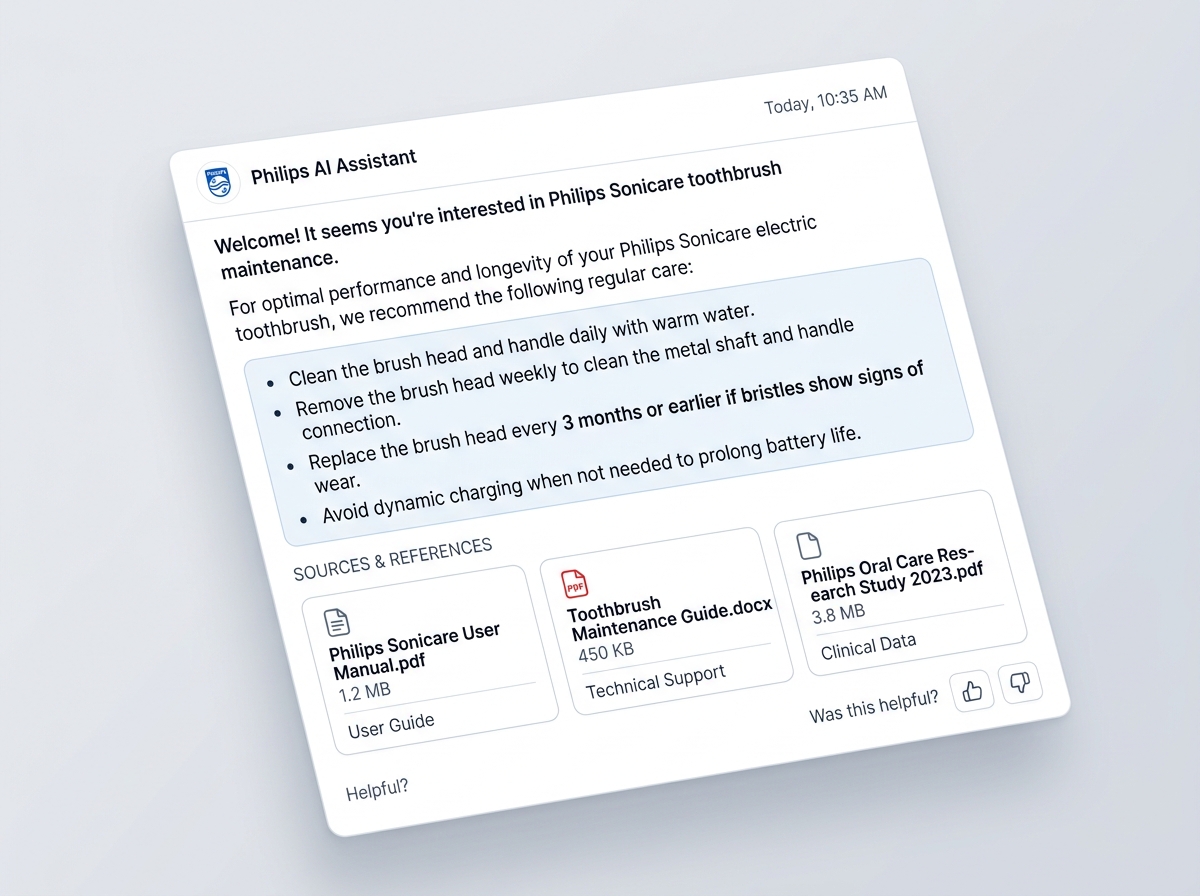
Structured Chatbot Response Spec
Research & Discovery Phase
The discovery phase focused on understanding how enterprise users searched for information and interacted with conversational AI systems. Activities included:
Workflows & Patterns
- • Reviewing existing enterprise support workflows.
- • Understanding user expectations for AI-assisted search.
- • Studying complex, documentation-heavy healthcare workflows.
Integration Guidelines
- • Analyzing common enterprise chatbot interaction patterns.
- • Collaborating with Product Managers to prioritize user needs.
- • Reviewing design system guidelines to ensure consistency.
The research highlighted the importance of reducing cognitive load while maintaining transparency in AI-generated responses.
Design Process
The design lifecycle followed an iterative and collaborative process across 8 milestones:
1. Requirements
Understanding goals, capabilities, and expectations.
2. UX Exploration
Exploring conversational layouts and interaction models.
3. Wireframing
Creating structural layouts focused on readability.
4. Hi-Fi UI
Developing polished interfaces aligned with guidelines.
5. Prototype
Building complete conversation and navigation flows.
6. Review
Gathering stakeholder feedback and usability reviews.
7. Handoff
Preparing detailed component specifications.
8. Design QA
Reviewing interfaces for design accuracy.
Enterprise Knowledge Discovery Journey
The chronological conversational navigation journey mapped for enterprise users:
- 01 Login
- 02 Access AI Chatbot workspace
- 03 Enter Natural Language Query prompt
- 04 AI Processes Request contextually
- 05 Retrieve Relevant Knowledge Sources from database
- 06 Generate structured Contextual Response
- 07 Display Supporting Reference document cards
- 08 User Refines Question context (Optional)
- 09 Save active Conversation history log
- 10 Continue operational clinical workflow
Key Design Decisions
Conversational First Interface
Instead of presenting a traditional search experience, the design prioritized natural conversations that encouraged users to interact with the AI assistant intuitively.
Structured AI Responses
Rather than long paragraphs, responses were divided into logical sections using headings, bullet points, and expandable cards to improve readability.
Source Transparency
Responses surfaced supporting document links, helping healthcare professionals validate the origin of AI-generated information and increasing trust.
Progressive Conversation History
Previous conversations remained accessible through a collapsible history panel, allowing users to revisit discussions without cluttering the primary workspace.
Enterprise-Friendly Layout
A clean interface with generous spacing, clear typography, and minimal distractions ensured the chatbot remained approachable for users across varying technical backgrounds.
Key Features Mapped
Natural Language Search
Users could ask questions using conversational language instead of relying on exact keywords.
Context-Aware Responses
Chatbot generated responses by understanding queries within their broader context, delivering relevant answers.
Conversation History
Users could revisit previous discussions and continue interrupted conversations easily.
Suggested Prompts
Predefined prompt suggestions helped new users quickly understand chatbot capabilities.
Document References
AI-generated answers included links to supporting documentation for independent validation.
Smart Follow-Ups
Chatbot proactively suggested related questions, encouraging deeper exploration of topics.
Interactive Prototype Details
The interactive prototype demonstrated the complete enterprise chatbot experience, including:
- • **Initial onboarding** and prompt cards suggestions.
- • **Conversational interactions** and AI-generated responses.
- • **Source references** link highlights.
- • **Conversation history indexes** collapse panels.
- • **Feedback rating mechanisms** input logs.
- • **Multi-step query refinement** logic.
"The prototype allowed stakeholders to validate usability before development commenced and facilitated early design discussions around interaction behavior."
Technical Challenges
Dense Information Display
Presenting large volumes of AI-generated information without overwhelming clinical users.
Workflow Balancing
Balancing conversational interactions with structured, traditional enterprise layouts.
Maintaining User Trust
Maintaining user trust in AI-generated answers through clear explainability designs.
Component Reusability
Designing reusable chatbot components capable of supporting future updates.
The Final Solution
The final solution delivered a clean, scalable conversational experience tailored for enterprise healthcare environments. By combining natural language interactions with structured response layouts and transparent information sourcing, the chatbot reduced friction in knowledge discovery while maintaining user confidence in AI-assisted workflows. Collaborative design iterations ensured the interface remained consistent with Philips' enterprise ecosystem.
Business Impact
Mapped Business Outcomes
- • **Simplifying Access:** Streamlined retrieval of clinical protocols and device manuals.
- • **Reduced manual search dependency:** Minimised reliance on customer support lines.
- • **Encouraging AI adoption:** Showcased clear RAG usability metrics.
- • **Reusable design patterns:** Established templates for future AI-powered healthcare layouts.
Team Collaboration
This project was highly collaborative and involved continuous communication across multiple teams. I worked closely with:
Deliverables Mapped
- UI Design Exploration
- High-Fidelity User Interfaces
- Interactive Prototypes
- Conversation Flow Designs
- Component Refinements
- Design System Contributions
- Developer Handoff Specifications
- Interaction Documentation
Key Learnings
Usability, Transparency & Trust
Working on an enterprise AI chatbot reinforced the importance of designing conversations that balance usability, transparency, and trust. Unlike consumer chatbots, enterprise users expect responses that are structured, verifiable, and directly actionable. The project also highlighted the value of close collaboration within design teams, where iterative refinement and shared ownership led to a more polished and cohesive user experience. It strengthened my ability to contribute effectively within cross-functional product teams while designing scalable AI-powered enterprise solutions.
Summary & Highlights
Knowledge Discovery Transformed
By collaborating on the design of Philips' enterprise AI chatbot, we transformed complex documentation and knowledge retrieval workflows into a conversational, user-centered experience. The resulting solution simplified access to critical information, improved productivity, enhanced trust through transparent AI interactions, and established scalable design foundations for future enterprise AI initiatives within the Philips healthcare ecosystem.