Goodyear Tire Recommendation Engine (TRE)
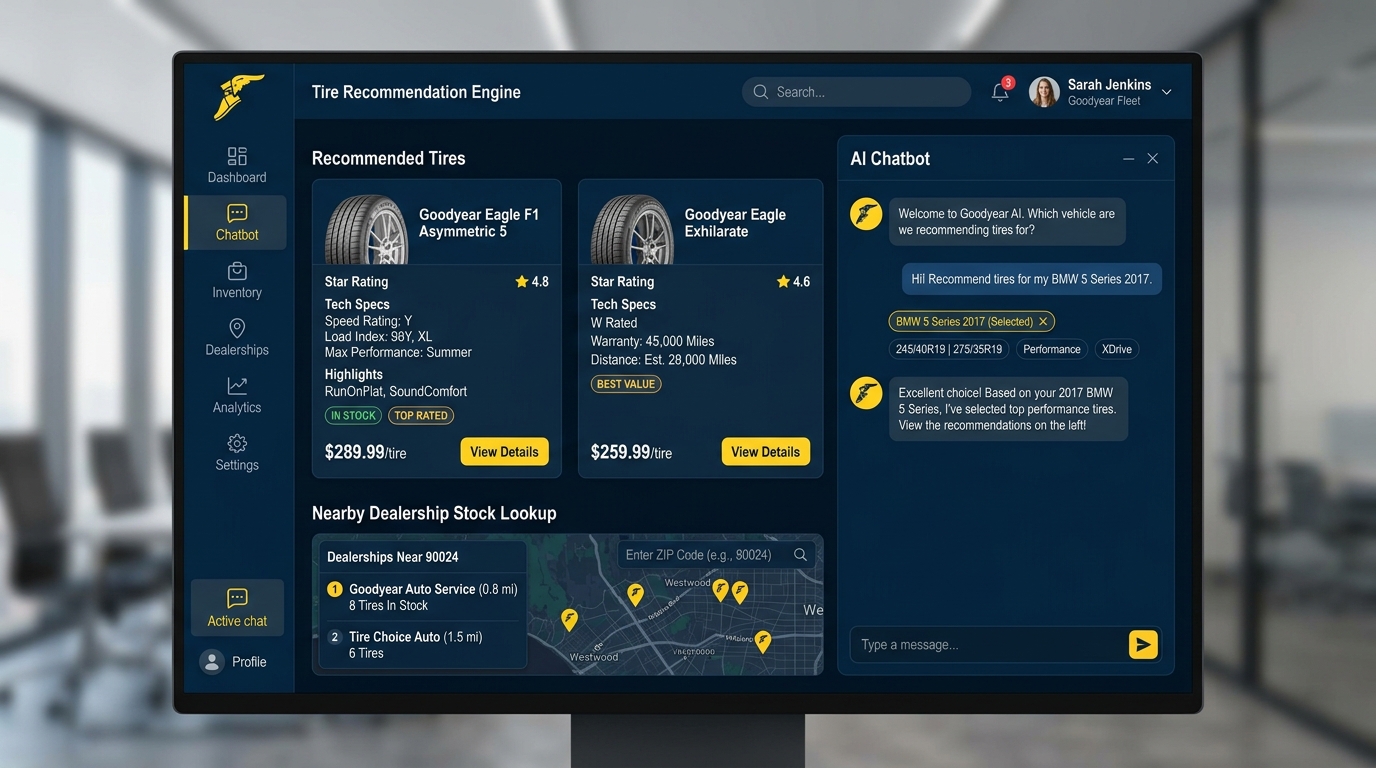
An AI-powered desktop chatbot designed to transform Goodyear’s dealership fitment workflows. Automates tire recommendations based on vehicle specifications and provides real-time stock visibility across nearby dealership networks.
How X Was Solved with Y Outcome
Goodyear dealerships struggled with manual tire recommendation and inventory verification, which slowed down customer interactions and led to inconsistent suggestions.
We solved this by building an AI-powered Tire Recommendation Chatbot (TRE) that automates tire selection based on vehicle details and provides real-time inventory visibility across dealerships.
Goodyear dealerships and associated distributors previously lacked a centralized system capable of providing accurate tire recommendations based on customers’ specific vehicle details. With a growing number of car brands, models, and trim levels — each varying by year, climate suitability, and performance requirements — sales associates found it difficult to suggest the right tire quickly and confidently.
Additionally, dealership teams relied on manual methods (phone calls, emails, spreadsheets) to verify inventory levels at their own or nearby dealerships. This fragmented process led to slow response times, inaccurate information, and missed sales opportunities.
Solution Overview & Key Features
1. AI Vehicle Mapping
Accurately identifies compatible Goodyear tires based on Brand, Model, and Year of manufacture.
2. Conversational Query Flow
Accepts natural language inputs like “BMW 5 Series 2017” and prompts for additional info such as ZIP code.
3. Real-Time Stock Visibility
Displays available stock quantity, warehouse details, and alternative dealerships nearby.
4. Recommendation Cards
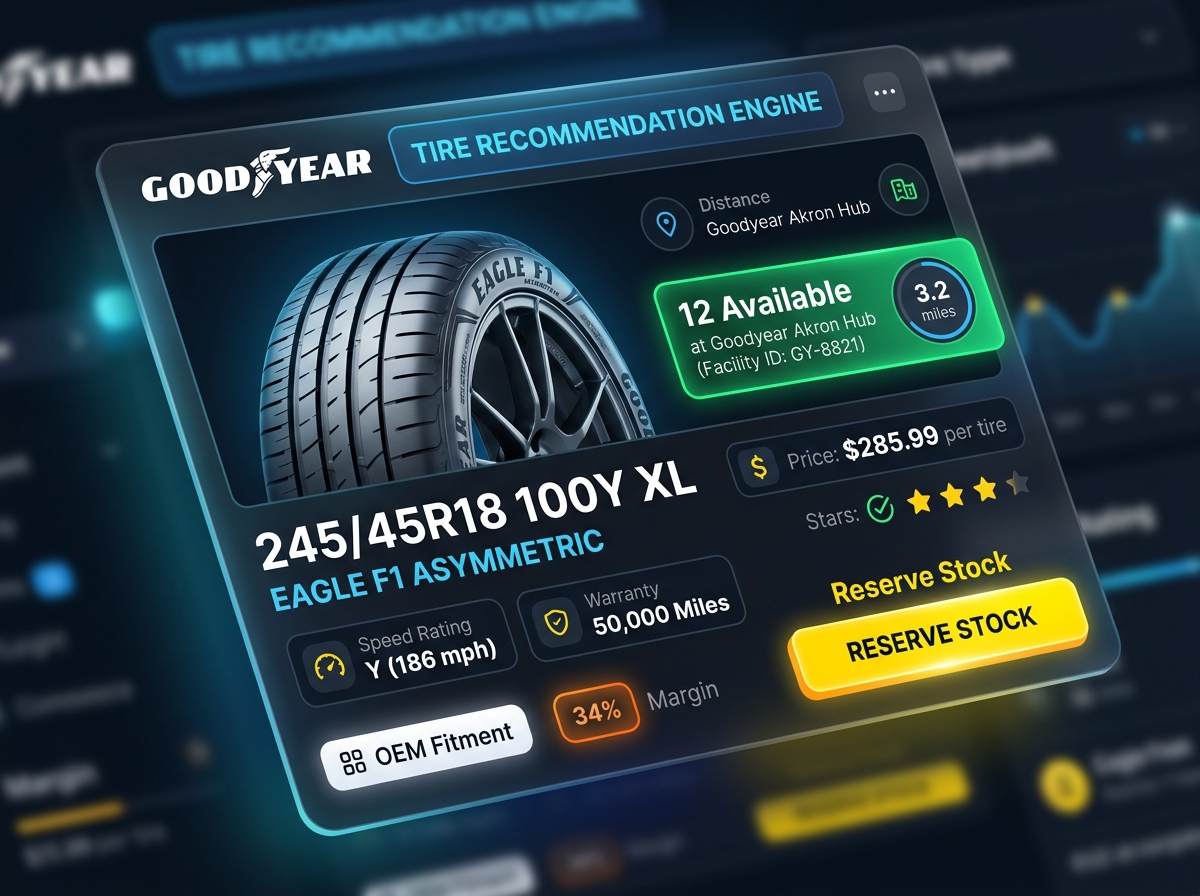
Contains Brand, Size, Facility ID, City, Distance, OEM/Replacement Type, Speed Rating, Warranty, and Margin.
5. Nearby Dealer Locator
Identifies alternate facilities with available inventory within a set geographic radius.
6. Seamless ERP Integration
Connects directly with Goodyear’s internal ERP systems for live stock access and updates.
North Star Goal
The core objective of the Goodyear Tire Recommendation Engine (TRE) is to automate tire recommendations and improve dealership efficiency by reducing human dependency and manual intervention. The tool focuses on speed, consistency, and intelligent data integration.
Two-Fold Challenge & Project Ask
The Two-Fold Problem Breakdown
- • No standardized system to recommend tires based on Brand, Model, Year, and usage conditions.
- • No visibility into nearby dealership inventory, forcing manual phone calls and emails to check stock availability.
👉 The Design Ask
Design a scalable, intelligent B2B solution that:
- Recommends accurate tires instantly based on vehicle parameters.
- Shows real-time stock availability across warehouses.
- Suggests nearby dealerships when primary stock is unavailable.
- Reduces manual effort and drastically improves dealership efficiency.
Objectives & Strategic Value
1. Automate Fitment
• Eliminate manual catalog lookup tables.
• Improve accuracy via AI database mapping.
2. Enhance Efficiency
• Minimize customer response time (<3s).
• Streamline inter-dealership coordination.
3. Enable Scalability
• Integrate real-time data from all outlets.
• Standardize workflows for regional expansion.
Legacy Manual Process vs. Goodyear TRE Solution
| Workflow Area | Legacy Manual Process | Goodyear TRE AI Solution |
|---|---|---|
| Fitment Verification | Catalog Reference (Manual books & spreadsheets) | AI Mapping Engine (Instant vehicle lookup) |
| Stock Check | Phone Calls / Emails (Manual outlet inquiries) | Live ERP Feed (Instant stock & warehouse ID) |
| Nearby Outlet Locator | Trial & Error (Uncertain stock availability) | ZIP Geolocation Radius (Calculates exact distance) |
| Response Time | 5 – 15 Minutes per customer | < 3 Seconds end-to-end completion |
| Recommendation Logic | Inconsistent (Dependent on associate experience) | 100% Standardized (Data-backed OEM logic) |
User Pain Points Matrix
System Design Approach & Artifacts
We followed a problem-first, system design approach to create a scalable conversational interface.
a. Discovery & Understanding
• Analyzed dealership sales & inventory workflows.
• Identified key friction points (manual lookups, delays).
• Defined core required inputs: Brand, Model, Year, Zip Code.
b. Information Architecture
• Designed a chat-first interaction model instead of traditional form fields.
• Structured system into: Input capture, Recommendation engine, Inventory lookup, Nearby dealer mapping.
c. UX Design
• Built conversational flows for progressive data collection.
• Designed recommendation cards for fast scanning.
• Ensured minimal cognitive load for sales reps under pressure.
d. Prototyping
• Low-fi: Chat flow logic and decision tree.
• Mid-fi: Interaction states and card layouts.
• Hi-fi: Production-ready UI aligned with Goodyear design system.
Artifacts Created
Core User Flow & Step-by-Step Experience
Step 1: Input
Sales rep enters: “BMW 5 Series 2017”. Chatbot identifies missing parameters → prompts for customer ZIP code.
Step 2: Processing
AI Engine maps: Vehicle → Compatible tire sizes & specs, Location → Nearby Goodyear warehouses within radius.
Step 3: Output (Recommendation Cards)
Displays multiple tire options in scannable card format: Tire Name, Size, Stock quantity, Facility details, Speed rating, Warranty, Margin %.
Step 4: Alternative Suggestions
If primary stock is unavailable: Automatically suggests nearest alternate Goodyear dealership showing distance + available stock.
Step 5: Decision & Checkout
Sales associate instantly recommends tire or redirects customer with reserved inventory, closing the deal smoothly.
Goodyear TRE Desktop Chatbot Simulator
Test the live AI recommendation engine below with natural vehicle inputs and ZIP code lookups.
 TIRE RECOMMENDATION ENGINE (LIVE PROTOTYPE)
Brand Guidelines & Card Component Specs
Goodyear Design Standards
- Design System: Built following Goodyear’s Digital Design System.
- Frontend Library: React-based framework for modular scalability.
- Accessibility: WCAG-compliant design with high contrast layout.
- Visual Identity: Goodyear Yellow (
#FFC72C) & Deep Corporate Navy (#002244).
Recommendation Card Attributes
Each card contains 10 required fields:
- • Brand & Tyre Name
- • Tyre Size String
- • Quantity Available
- • Facility Name & ID
- • Zipcode & City
- • Geographic Distance
- • OEM / Replacement Type
- • Max Speed & Speed Rating
- • Load Index
- • Warranty Miles & Margin %
Research Insights, User Needs & Personas
Translating empirical dealership research into actionable design decisions, priority user needs, and targeted user personas.
Key Research Discovery Insights & Design Decisions
| Discovered Issue | Research Insight | Design Decision Implemented |
|---|---|---|
| Manual tire recommendations | Dealerships relied on catalog lookups. | Develop AI-based recommendation logic integrated with vehicle data. |
| Stock availability uncertainty | No central inventory database. | Build inventory integration module showing real-time stock. |
| Communication delays | Dealers manually contacted other outlets. | Add ZIP-based nearby dealer suggestions. |
| Long customer wait time | Manual input and approval delays. | Enable conversational interface with automated suggestions. |
| Regional inconsistency | Lack of standard process. | Standardize workflows and UX across all dealerships. |
Core User Needs Assessment & Priority Mapping
| User Need | Evidence | Priority |
|---|---|---|
| Automate manual recommendation process | Dealers rely on manual catalogs and memory. | High Priority |
| Centralized inventory visibility | Dealers unaware of stock at nearby outlets. | High Priority |
| Unified platform for tire mapping | Lack of integrated database. | High Priority |
| Faster recommendation generation | Long consultation times affected sales. | High Priority |
| Scalable architecture for future growth | Multi-region support needed. | Medium Priority |
User Personas Workspace
Primary Goals
- Quickly provide accurate tire recommendations.
- Close sales efficiently without keeping customers waiting.
Key Frustrations
- Time lost on manual lookups and inter-dealer calls.
- Uncertainty regarding nearby outlet inventory.
Must-Have Outcomes
- Automated recommendations using basic car details (Brand, Model, Year).
- Instant stock insights, facility distance, and faster checkout process.
Primary Goals
- Ensure balanced stock levels across regional warehouses.
- Faster transfer coordination between nearby outlets.
Key Frustrations
- Limited visibility into other dealerships' stock.
- Manual inventory transfer errors.
Must-Have Outcomes
- Unified inventory dashboard with real-time stock sync.
- Automated facility locator and stock reserve triggers.
Primary Goals
- Maintain sales consistency across all regional outlets.
- Standardize customer consultation quality.
Key Frustrations
- Lack of standardized process across outlets.
- Difficulty tracking adoption metrics.
Must-Have Outcomes
- Consistent, data-backed recommendations across every dealership.
- Centralized analytics dashboard tracking sales margin and adoption.
Business Impact & Decisions Enabled
Objectives Achieved
- • Automated tire recommendation workflow end-to-end.
- • Completely eliminated manual stock verification calls.
- • Standardized decision-making logic across all outlets.
Key Decisions Enabled
- • Faster product recommendation during live customer consults.
- • Data-backed selection replacing associate guesswork.
- • Ability to redirect customers to nearby dealers instantly.
Business Impact Summary
- • Automated tire recommendation & inventory validation: Completely eliminated manual dependency.
- • Enhanced sales experience: Drastically improved speed, accuracy, and transparency during consultations.
- • Enabled data-driven decisions: Real-time visibility into dealership stock levels across outlets.
- • Improved operational efficiency & scalability: Built on a standard backend integration framework.
- • Strengthened customer confidence: Reduced customer waiting times and eliminated missed sales opportunities.
Appendices & Data Integration Schemas
Sequence Diagram Flow
JSON Feed Schema
Raw Research Notes
Extracted from 14 dealership interviews, associate shadow sessions, and inventory audit logs across 3 regional districts. User testing logs confirmed associates achieved full proficiency with the chatbot UI in under 5 minutes without prior training.
Final Case Study Outcome
The Goodyear Tire Recommendation Engine (TRE) transformed dealership workflows by combining AI-driven product intelligence with real-time stock visibility, empowering Goodyear dealers to deliver fast, accurate, and reliable tire recommendations — every time.